
How Much Is Your Healthcare Staffing Candidate Database Worth?
Healthcare staffing agencies invest significant amounts of money and recruiter time acquiring clinicians.
Candidates enter the database through job boards, lead-generation platforms, referrals, organic applications, recruiter sourcing, previous assignments, and marketing campaigns.
Over time, that investment can create a database containing tens or even hundreds of thousands of clinicians.
But the size of the database does not determine its value.
Its value depends on how effectively the agency can turn those existing candidate relationships into future placements.
A candidate who applied two years ago may still be a nurse today. A clinician who declined one assignment may be interested in another. Someone who was unavailable six months ago may be actively looking now.
The opportunity already exists inside the database.
The challenge is finding it.
Your Candidate Database Is an Acquired Business Asset
Every clinician in a staffing agency’s database entered through some form of investment.
That investment may have included:
- Job board fees
- Candidate lead purchases
- Recruiter sourcing time
- Advertising spend
- Referral bonuses
- Marketing campaigns
- Application processing
- Credentialing activity
- Previous recruiter relationships
Even organically acquired candidates required organizational resources to attract, engage, and maintain.
Once those clinicians enter the database, the agency owns something valuable: an existing relationship with potential future workforce supply.
Yet many agencies continue investing heavily in acquiring new candidates while thousands of previously acquired clinicians receive little or no ongoing engagement.
Candidate Acquisition Cost Is Only Part of the Equation
Healthcare staffing agencies naturally monitor the cost of generating new candidates.
But another important question is:
How much value are you generating from candidates you’ve already paid to acquire?
Consider two agencies that each spend the same amount on candidate acquisition.
Agency A continuously depends on new leads to create recruiter activity.
Agency B acquires new candidates but also systematically reengages its existing database.
Agency B has another potential source of candidate supply without needing to reacquire every relationship from scratch.
This does not mean agencies should stop acquiring new candidates.
It means acquisition and database utilization should work together.
Why Candidate Databases Lose Apparent Value Over Time
Candidate records become less useful when the information inside them becomes outdated.
A clinician may have:
- Changed specialties
- Gained additional experience
- Obtained additional licenses
- Changed preferred locations
- Changed preferred shifts
- Changed compensation expectations
- Completed additional assignments
- Become available again
- Become interested in different types of work
The clinician may still be valuable even when the record is stale.
This distinction matters.
An outdated candidate record is not necessarily an outdated candidate.
The underlying relationship may still have significant value if the agency can reconnect with the clinician and refresh what it knows.
Database Size and Database Value Are Different
A large healthcare staffing database can look impressive.
But raw candidate count tells leadership very little about how much recruiting value the database is actually producing.
Imagine two hypothetical agencies.
Agency A
- 100,000 candidate records
- Limited systematic reengagement
- Most historical candidates rarely contacted
- Recruiters primarily work recent applicants
- Heavy dependence on new candidate acquisition
Agency B
- 50,000 candidate records
- Consistent database reengagement
- Candidate preferences regularly refreshed
- Existing candidates reconsidered for new jobs
- Recruiters receive reactivated candidate opportunities
Agency A has twice as many records.
Agency B may have the more valuable database.
The difference is utilization.
A Better Way to Think About Candidate Database Value
Instead of asking only how many candidates are stored in the ATS, agencies can evaluate several layers of database value.
1. Reachable Candidates
How many clinicians can the agency reasonably contact?
Records with invalid contact information have limited immediate value.
2. Engaged Candidates
How many clinicians respond when contacted?
Engagement begins turning a stored record back into an active relationship.
3. Qualified Candidates
How many responding clinicians still meet the agency’s recruiting requirements?
Their current profession, specialty, experience, licenses, availability, and preferences all matter.
4. Matchable Candidates
How many qualified clinicians align with current or anticipated job demand?
A highly qualified candidate still needs an appropriate opportunity.
5. Placeable Candidates
How many ultimately progress into submissions, interviews, offers, and placements?
This is where database activity becomes measurable business value.
The objective is to move more candidates through these stages without requiring recruiters to manually rediscover every opportunity.
The Database Utilization Funnel
Healthcare staffing agencies can think about their candidate database as a funnel:
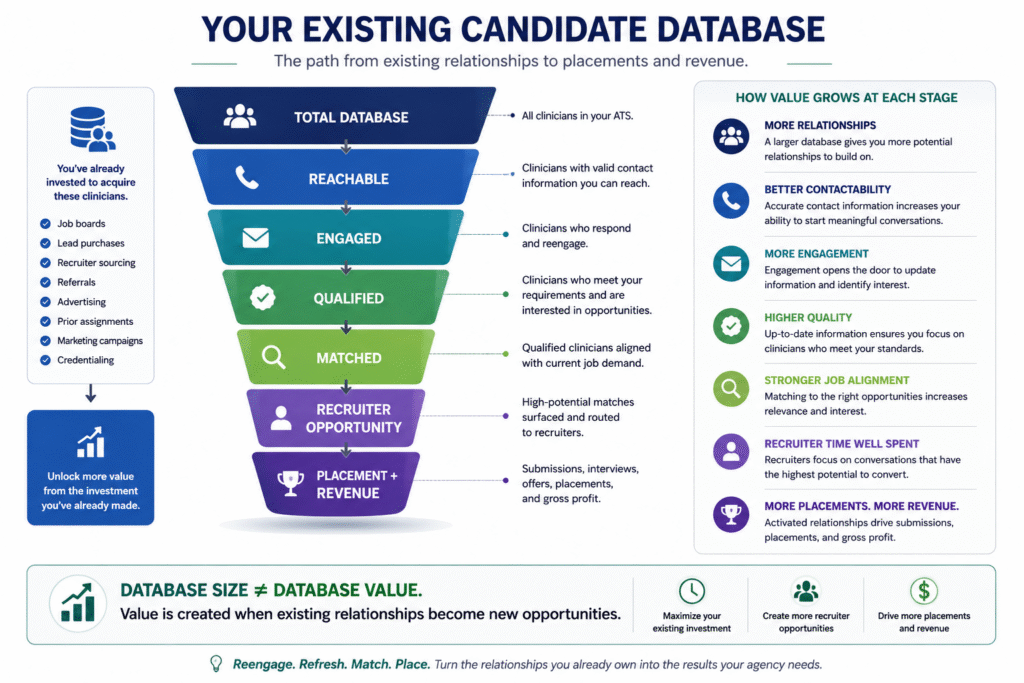
The number at the top matters.
But the economic value is created by what moves through the funnel.
A database containing 200,000 clinicians creates limited value if only a tiny fraction can realistically be identified, engaged, and converted into placements.
Measure Revenue Generated From Existing Candidates
One of the clearest ways to evaluate database performance is to track how much business originates from candidates who were already in the agency’s database.
Leadership can monitor:
- Existing candidates reengaged
- Candidate response rate
- Candidate profiles refreshed
- Qualified candidates rediscovered
- Job matches identified
- Candidates routed to recruiters
- Submissions from existing candidates
- Interviews from existing candidates
- Placements from existing candidates
- Gross profit generated from reactivated candidates
This begins connecting database utilization directly to financial performance.
Calculate the Value of a Rediscovered Candidate
Not every candidate who responds will become a placement.
That is normal.
The value comes from the economics across the entire reengagement process.
For example, an agency might reengage a group of previously acquired clinicians.
Some will not respond.
Some will respond but no longer be interested.
Some will update their preferences but not match a current position.
Some will become qualified recruiting opportunities.
And a smaller number will ultimately become placements.
The correct question is not:
Did every reengaged candidate become a placement?
It is:
Did the placements generated from the existing database produce more value than the cost required to rediscover them?
That is the economic foundation of candidate rediscovery.
Compare Rediscovery Cost With New Candidate Acquisition
Agencies should also compare the economics of generating placement opportunities from existing candidates against acquiring entirely new candidates.
New candidate acquisition may require:
- Job board spend
- Lead-generation fees
- Advertising
- Recruiter sourcing time
- Initial outreach
- Repeated follow-up
- Qualification
Existing candidates have already passed through at least part of that acquisition process.
The agency already has the relationship.
That can create an important economic advantage.
Candidate rediscovery does not eliminate acquisition cost. It gives agencies another way to generate returns from acquisition costs they’ve already incurred.
The Compounding Cost of Underutilized Candidate Acquisition
This becomes especially important for agencies that spend heavily on third-party candidate acquisition channels.
An agency may pay to acquire a clinician through a job board or lead-generation platform.
If that candidate does not immediately become a placement, the agency may eventually return to the same acquisition channels looking for additional candidates.
Meanwhile, the original clinician remains inside the ATS.
Over time, the agency can accumulate an increasingly valuable database while simultaneously becoming more dependent on external sources to create new recruiter activity.
The problem is not necessarily the acquisition channel.
The problem is failing to fully utilize what previous acquisition spending already created.
New Jobs Can Unlock Existing Database Value
Candidate database value also changes as job demand changes.
A clinician who does not fit today’s openings may fit tomorrow’s.
This makes new job creation an important database activation opportunity.
A more systematic process can look like this:
New Job Opens → Search Existing Candidate Supply → Identify Potential Matches → Reengage Candidates → Refresh Current Preferences → Confirm Interest → Route Qualified Opportunities to Recruiters
Instead of viewing the database as a static collection of historical applicants, the agency can continuously reconsider its existing candidate supply as new demand enters the business.
That makes the database more valuable over time.
Recruiter Capacity Limits Database Utilization
The biggest constraint is often not database size.
It is recruiter capacity.
A recruiter cannot personally maintain meaningful relationships with tens of thousands of clinicians.
As databases grow, manual reengagement becomes increasingly difficult.
Recruiters naturally prioritize candidates who recently applied, recently responded, or are already progressing through the recruiting process.
That makes operational sense.
But it can leave significant potential supply hidden deeper inside the database.
Technology can help perform the high-volume work required to identify which relationships deserve renewed recruiter attention.
AI Changes the Economics of Candidate Database Utilization
Historically, systematically reengaging a very large database required substantial recruiter capacity.
AI and automation can change that equation.
Technology can help agencies:
- Identify potentially relevant candidates
- Conduct initial reengagement
- Follow up consistently
- Refresh candidate preferences
- Update availability
- Capture current compensation expectations
- Identify potential job alignment
- Surface engaged candidates for recruiter involvement
The recruiter can then focus on the smaller subset of clinicians where a meaningful conversation may actually create value.
AI does not make the database valuable by itself.
It can make previously uneconomical levels of database engagement more practical.
Metrics Healthcare Staffing Leaders Should Track
Leadership teams interested in understanding candidate database value should consider tracking:
- Total candidate records
- Reachable candidate percentage
- Reengagement attempts
- Candidate response rate
- Candidate reactivation rate
- Profiles updated
- Qualified candidates rediscovered
- Matches generated from existing candidates
- Recruiter handoffs
- Submissions from existing candidates
- Placements from existing candidates
- Gross profit from existing candidates
- Cost per reactivated candidate
- Cost per qualified opportunity
- Cost per placement from database reengagement
Over time, these metrics provide a much clearer picture of database value than candidate count alone.
Frequently Asked Questions
How do you calculate the value of a healthcare staffing candidate database?
There is no single universal valuation formula. Operational value can be evaluated by measuring how many candidates are reachable, engaged, qualified, matchable, and ultimately converted into placements and gross profit.
Are old healthcare staffing candidates still valuable?
Potentially. A candidate’s availability, preferences, experience, licenses, or employment situation may have changed since the last interaction. Reengagement can determine whether an older candidate record represents a current recruiting opportunity.
Should staffing agencies stop buying candidate leads?
No. Candidate acquisition remains necessary for many agencies. Database reengagement complements acquisition by helping agencies generate additional value from clinicians they have already acquired.
How often should a healthcare staffing database be reengaged?
There is no single cadence appropriate for every candidate. Agencies should consider previous engagement, candidate preferences, available jobs, specialty demand, and communication frequency when designing reengagement strategies.
Can new jobs trigger candidate database reengagement?
Yes. New positions can provide a natural reason to reconsider existing candidates whose profession, specialty, location, availability, or other preferences may align with the opportunity.
What makes a candidate database more valuable?
A useful candidate database contains reachable clinicians, current information, meaningful candidate relationships, and processes that allow the agency to identify and activate candidates when relevant opportunities arise.
Turn Your Existing Candidate Database Into a Working Recruiting Asset
Your candidate database represents years of acquisition spending, recruiter effort, applications, conversations, and relationships.
Its value should not be measured only by how many records it contains.
The better question is how effectively those relationships can generate future recruiting opportunities.
FindFill helps healthcare staffing agencies reconnect with existing clinicians, refresh candidate preferences, identify potential job matches, and surface qualified opportunities to recruiters.
Learn how FindFill helps staffing agencies reengage existing candidate databases →