
What Is Candidate Rediscovery in Healthcare Staffing?
A practical guide to finding qualified clinicians already in your database before spending more to acquire new candidates.
What Is Candidate Rediscovery?
Healthcare staffing agencies spend significant amounts of time and money building candidate databases through job boards, lead-generation platforms, referrals, advertising, applications, and years of recruiter activity.
But only a fraction of those clinicians are actively engaged with recruiters at any given moment.
Candidate rediscovery is the process of identifying qualified clinicians already in an agency’s database who may be relevant for current opportunities, even if they have not recently been active with the agency.
Instead of treating every new job as a reason to begin another candidate search from scratch, rediscovery asks a different question:
Who have we already recruited who could be right for this opportunity now?
That distinction matters because a dormant candidate is not necessarily an uninterested candidate. Their circumstances may simply have changed.
Why Qualified Candidates Become Invisible
Healthcare staffing databases naturally accumulate dormant candidates over time.
A clinician may have:
- Applied when the timing was not right
- Declined a previous opportunity
- Completed an assignment and stopped hearing from the agency
- Changed preferred locations
- Gained new specialty experience
- Changed compensation expectations
- Become available after previously being unavailable
- Lost contact with a recruiter who left the agency
- Stopped responding to outreach that was not relevant at the time
None of those situations necessarily means the clinician should be treated as a dead lead.
The problem is that candidate data becomes less useful as it becomes less current.
A candidate record may tell you what someone wanted 12 months ago. It does not necessarily tell you what they want today.
Candidate Rediscovery vs. Candidate AcquisitionCandidate acquisition and candidate rediscovery solve two different problems.
Candidate acquisition adds new clinicians to the database.
Candidate rediscovery creates another opportunity to generate value from clinicians the agency has already acquired.
Agencies still need candidate acquisition. New clinicians, specialties, markets, and relationships continually need to enter the recruiting funnel.
But acquisition does not have to be the first response to every open job.
A healthier recruiting strategy uses both:
Acquire new candidates when additional supply is needed. Rediscover existing candidates when relevant supply may already exist.
Why Candidate Rediscovery Matters Economically
Every clinician already in an agency’s database represents an acquisition investment that has already been made.
The agency may have originally paid for:
- Job board access
- Candidate leads
- Advertising
- Referral bonuses
- VMS or marketplace participation
- Recruiter sourcing time
- Marketing campaigns
- Technology used to capture and manage the candidate
When that clinician becomes dormant, the original acquisition cost does not disappear.
The question becomes whether the agency will continue extracting value from that relationship or repeatedly pay to create new ones.
This makes candidate rediscovery partly a recruiting strategy and partly a database utilization strategy.
Rediscovery Starts With Reengagement
Finding an old candidate record is only the beginning.
The agency still needs to determine whether the information in that record remains accurate.
Effective rediscovery therefore requires reengagement.
The agency may need to confirm or update information such as:
- Current availability
- Preferred states or locations
- Recent specialty experience
- Preferred shifts
- Contract or per diem interest
- Compensation expectations
- Licensure
- Interest in current opportunities
This turns a static candidate record into current recruiting intelligence.
A clinician who appeared irrelevant based on old information may suddenly become highly relevant once their preferences are refreshed.
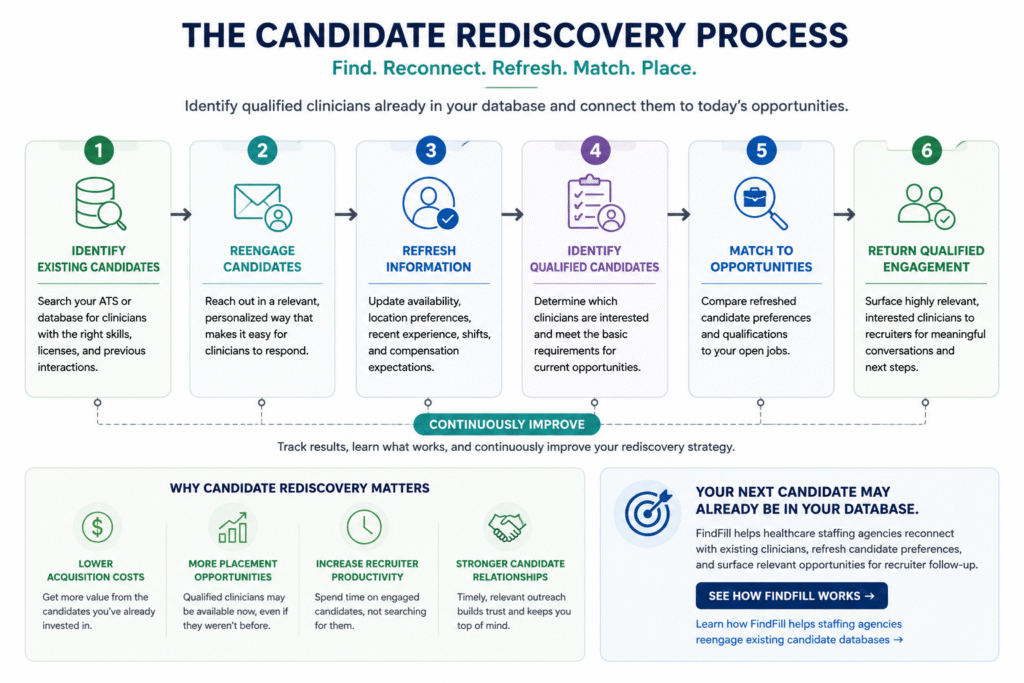
The Candidate Rediscovery Process
A structured rediscovery workflow can be thought of as six steps:
1. Identify Existing Candidates
Start with clinicians already present in the ATS, CRM, or candidate database.
2. Reengage Candidates
Reconnect in a way that gives clinicians an easy opportunity to indicate whether they are open to new opportunities.
3. Refresh Candidate Information
Capture current preferences rather than relying entirely on historical data.
4. Identify Qualified Candidates
Determine which clinicians are both interested and potentially appropriate for current needs.
5. Match Candidates to Opportunities
Compare refreshed candidate preferences and qualifications against available jobs.
6. Return Qualified Engagement to Recruiters
Recruiters can then focus their attention on clinicians who have demonstrated current interest and relevance.
The goal is not to remove recruiters from the process.
The goal is to give recruiters better conversations to have.
Candidate Rediscovery Should Not Mean Mass Blasting Your Database
Rediscovery can become counterproductive when every clinician receives every job.
High-volume, irrelevant outreach teaches candidates to ignore future communication.
Instead, agencies should increasingly use the information they already possess to make outreach more relevant.
That can include:
- Profession
- Specialty
- Location
- License
- Previous assignments
- Historical preferences
- Current availability
- Compensation expectations
- Prior engagement
As candidate information becomes more current, outreach can become increasingly targeted.
Job Openings Can Become Rediscovery Triggers
Candidate rediscovery does not have to happen only through broad database campaigns.
New jobs can also become triggers.
When an agency receives a new opportunity, it can ask:
Which clinicians already in our database appear relevant to this job?
Those candidates can then be reengaged to determine whether their current interests align with the opportunity.
This creates a different recruiting sequence:
New Job → Search Existing Database → Reengage Potential Matches → Refresh Preferences → Identify Interested Candidates → Recruiter Conversation
Only after existing candidate opportunities have been explored does additional candidate acquisition necessarily need to become the next step.
Candidate Rediscovery and Recruiter Productivity
Recruiter time is limited.
Every hour spent searching old records, repeatedly contacting unresponsive candidates, or manually determining who might still be interested is an hour that cannot be spent developing active candidates.
Candidate rediscovery can help separate two types of recruiting work:
Discovery work: determining who might be interested.
Recruiting work: building relationships with candidates who have demonstrated interest.
Technology can increasingly assist with the first.
Recruiters remain especially valuable for the second.
Candidate Rediscovery Is Not the Same as Replacing Recruiters
The objective is not to automate the recruiter relationship.
It is to improve what reaches the recruiter.
A rediscovery system can help identify candidates, reconnect with them, refresh information, and determine whether a relevant opportunity exists.
Once genuine interest emerges, the recruiter can step into a much more valuable conversation.
Instead of:
“Are you looking for a new assignment?”
the conversation can begin much closer to:
“I see you’re open to opportunities in North Carolina and looking for an ER contract. Let’s talk about what we have available.”
That is a fundamentally different starting point.
Measuring Candidate Rediscovery
Agencies implementing a rediscovery strategy should track more than message volume.
Useful metrics include:
- Candidates reengaged
- Candidate response rate
- Candidate profiles refreshed
- Candidates expressing current interest
- Qualified candidates identified
- Candidates matched to open jobs
- Recruiter handoffs
- Submissions generated
- Placements generated
- Revenue or gross profit generated from rediscovered candidates
Over time, agencies can also compare those results with the cost of acquiring equivalent candidate opportunities through external sources.
Candidate Acquisition and Rediscovery Should Work Together
Candidate rediscovery does not eliminate the need for job boards, advertising, referrals, marketplaces, or other acquisition channels.
Those channels remain important ways to continually expand an agency’s candidate network.
But there is an important difference between continuing to acquire candidates and depending almost entirely on continued acquisition to create recruiting activity.
A strong agency can do both.
Keep building the database while creating systems that continually extract more value from the database already built.
Frequently Asked Questions
What is candidate rediscovery in healthcare staffing?
Candidate rediscovery is the process of identifying and reengaging clinicians already in a staffing agency’s database to determine whether they may be interested and qualified for current opportunities.
Is candidate rediscovery the same as candidate reengagement?
They are closely related but not identical. Reengagement is the process of reconnecting with candidates. Rediscovery is the broader process of finding relevant candidates again, refreshing their information, determining current interest, and connecting them with opportunities.
Why do staffing agencies lose visibility into existing candidates?
Candidate preferences, availability, experience, and circumstances change over time. Recruiter turnover and inconsistent follow-up can also cause qualified candidates to become inactive within an agency’s database.
Does candidate rediscovery replace candidate acquisition?
No. Agencies still need new candidates entering their databases. Rediscovery helps agencies get more value from candidates they have already spent resources acquiring.
Can AI help with candidate rediscovery?
Yes. AI can assist with reengagement, collecting updated candidate information, evaluating potential matches, and identifying candidates who may warrant recruiter attention. Recruiters can then focus on the relationship-driven portions of the recruiting process.
Your Next Candidate May Already Be In Your Database
FindFill helps healthcare staffing agencies reconnect with existing clinicians, refresh candidate preferences, and surface relevant opportunities for recruiter follow-up.
Learn how FindFill helps staffing agencies reengage existing candidate databases →