
How Healthcare Staffing Agencies Can Reengage Their Existing Candidate Database
A practical framework for reconnecting with inactive clinicians, refreshing candidate preferences, and creating new placement opportunities from relationships your agency has already built.
Healthcare staffing agencies invest heavily in building candidate databases through job boards, referrals, advertising, VMS relationships, and lead-generation platforms. But over time, thousands of qualified clinicians become dormant as timing changes, recruiters move on, or communication simply stops. Healthcare staffing database reengagement creates a systematic way to reconnect with those clinicians and turn existing candidate relationships back into placement opportunities.
Candidates enter through job boards, lead-generation platforms, referrals, applications, recruiter outreach, previous assignments, and years of recruiting activity. Over time, an agency can accumulate tens or hundreds of thousands of clinician records.
But acquiring a candidate does not mean that relationship continues to generate value.
Clinicians stop responding. Recruiters change. Candidate preferences become outdated. New jobs arrive after the original conversation ended. Qualified clinicians who were not right for one opportunity may never be contacted about the next one.
The result is a common recruiting problem:
Agencies continue investing in new candidate acquisition while potentially valuable relationships already exist inside their database.
Database reengagement is the process of systematically reconnecting with those clinicians and determining who may be ready for another opportunity.
What Is Candidate Database Reengagement?
Candidate database reengagement is the process of reconnecting with clinicians who already exist within a staffing agency’s candidate database but are no longer actively engaged in the recruiting process.
These candidates might include:
- Previous applicants
- Former travelers or contractors
- Clinicians who previously spoke with a recruiter
- Candidates who were submitted but not placed
- Candidates who previously declined an opportunity
- Clinicians whose availability was months away
- Candidates who stopped responding
- Leads acquired through job boards or other recruiting channels
The objective is not simply to send another message.
Effective reengagement determines whether something has changed.
A clinician who was unavailable six months ago may be available today. Someone who previously wanted Florida may now be looking in North Carolina. A candidate who declined one job may be interested in a completely different opportunity.
The candidate record may be old. The candidate’s potential value is not necessarily old.
Why Healthcare Staffing Databases Become Dormant
A dormant database does not necessarily mean recruiters failed.
It is a natural consequence of high-volume recruiting.
Consider what happens throughout a typical candidate lifecycle.
A clinician enters the database. A recruiter reaches out. Perhaps the timing is wrong. Maybe the clinician wants a location the agency doesn’t currently have. Maybe compensation doesn’t align. Perhaps the clinician accepts another position.
The recruiter appropriately moves on to candidates who can fill today’s jobs.
Six months later, circumstances may have changed, but the agency has thousands of other candidates requiring attention.
Without a systematic reengagement process, that earlier relationship can effectively disappear.
Common causes include:
- Recruiters prioritizing today’s active candidates
- Candidate preferences becoming outdated
- Recruiter turnover
- Large database sizes
- Candidates becoming available again without notifying the agency
- New jobs arriving after previous conversations ended
- Inconsistent follow-up
- Limited recruiter bandwidth
This creates an important distinction:
A dormant candidate is not necessarily an uninterested candidate.
Sometimes the agency simply hasn’t had a reason or scalable process to restart the conversation.
The Economics of Candidate Acquisition vs. Reengagement
Healthcare staffing agencies routinely invest in candidate acquisition.
That may include:
- Job boards
- Lead-generation platforms
- Digital advertising
- Referral programs
- Recruiter sourcing
- Events
- Organic marketing
- Database purchases or partnerships
Those investments create candidate relationships that become part of the agency’s recruiting asset base.
Yet agencies can fall into a cycle:
Need more candidates → acquire more leads → recruiters work the newest leads → older candidates receive less attention → acquire more leads again.
New candidate acquisition will always have a role.
But before assuming the agency needs more candidates, leadership should also ask:
How much opportunity already exists in the database we’ve paid to build?
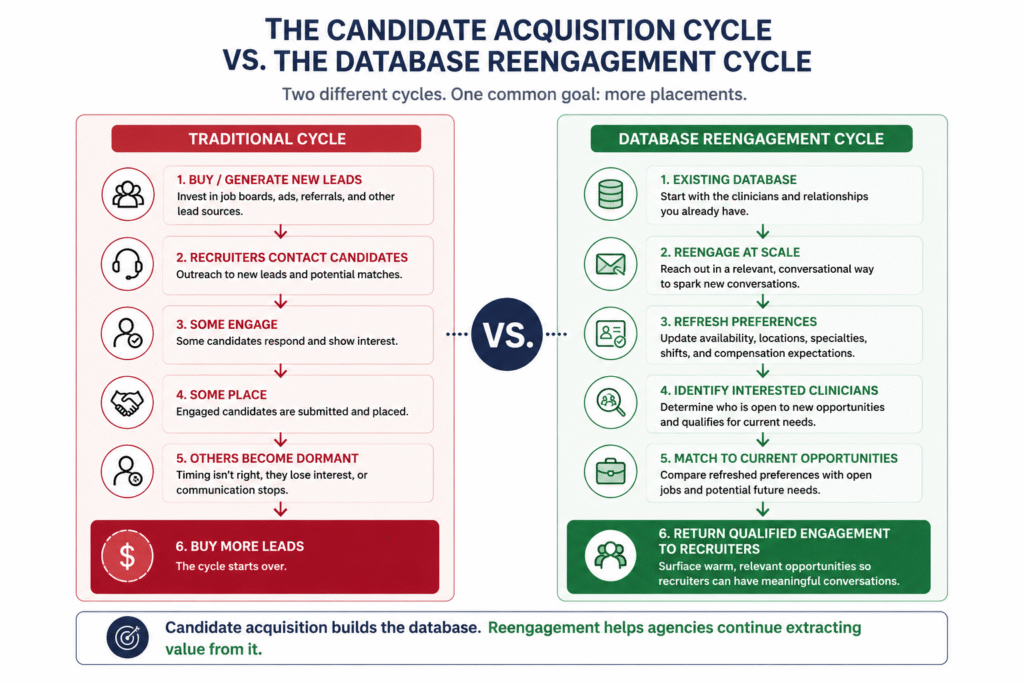
Candidate acquisition builds the database. Reengagement helps agencies continue extracting value from it.
Not Every Candidate Should Be Reengaged the Same Way
One of the biggest mistakes an agency can make is treating database reengagement like a mass marketing blast.
A database may contain clinicians at dramatically different stages.
For example:
Candidate A: Applied three months ago but wasn’t available until September.
Candidate B: Completed an assignment with the agency last year.
Candidate C: Was interested in North Carolina but the agency had no appropriate opening.
Candidate D: Has not responded to anything in three years.
Those candidates should not necessarily receive the same conversation.
A stronger strategy uses existing candidate information to determine why reengagement makes sense now.
Start With Candidate Segmentation
Before beginning a reengagement campaign, determine which clinicians should be included.
Useful segmentation criteria can include:
- Profession
- Specialty
- State or license
- Previous preferred locations
- Previous assignment history
- Last contact date
- Previous availability
- Previous compensation requirements
- Current or historical job matches
- Candidate status within the ATS
Segmentation makes outreach more relevant and allows agencies to prioritize candidate groups with the highest potential value.
For example, an agency with several new ER RN openings in North Carolina could prioritize nurses with relevant specialties, licenses, or previously expressed geographic interest rather than reengaging the entire database indiscriminately.
Reengagement Should Refresh Candidate Data
Getting a clinician to respond is only the beginning.
The agency needs to learn what is true today.
For travel and contract clinicians, useful information may include:
- States they are currently considering
- Specialties worked recently
- Availability
- Preferred shifts
- Compensation expectations
- Contract versus per diem interest
- Other relevant job preferences
This converts an old candidate record into current recruiting intelligence.
A recruiter can then approach the conversation knowing significantly more than:
“This person responded to a text.”
The better outcome is:
This clinician responded, is interested in opportunities, and we now understand what they are looking for.
Use Conversations, Not Forms
Reengagement should feel like recruiting, not database maintenance.
Clinicians may be less likely to engage if the first interaction asks them to complete a lengthy form, update an entire profile, or repeat information the agency should already know.
A conversational approach allows the agency to progressively confirm and update information.
For example:
- Confirm whether the clinician is open to opportunities.
- Confirm or update location preferences.
- Confirm recent specialty experience.
- Determine availability.
- Clarify shift preferences.
- Understand compensation expectations when appropriate.
Not every question needs to arrive at once.
The objective is to reduce friction while collecting enough information to determine whether a meaningful recruiting opportunity exists.
Match Reengagement to Actual Jobs
Database reengagement becomes considerably more valuable when it is connected to current demand.
There are two primary approaches.
Database-Triggered Reengagement
The agency selects a group of dormant candidates and systematically determines who may be open to new opportunities.
This can uncover candidates for multiple existing or future jobs.
Job-Triggered Reengagement
A new job enters the agency’s system.
Instead of only advertising the position or waiting for new applicants, the agency identifies existing candidates whose historical profile suggests they may be a potential fit.
Those clinicians can then be reengaged specifically because a relevant opportunity exists.
This creates a powerful recruiting question:
Before buying another candidate for this job, who have we already acquired that might be a fit?
Recruiters Should Receive Opportunities, Not More Administrative Work
The purpose of reengagement automation should not be to replace recruiters.
It should help recruiters spend more time where their expertise matters.
Recruiters are particularly valuable when:
- A clinician is genuinely interested
- Preferences have been established
- A relevant job exists
- Questions become nuanced
- Compensation needs to be discussed
- Trust and relationship-building matter
- A candidate is approaching submission or placement
Conversely, repeatedly checking whether thousands of inactive clinicians might be interested is difficult to scale manually.
A strong reengagement system handles repetitive early-stage work and brings recruiters into the process when human involvement becomes more valuable.
Where AI Can Help Candidate Reengagement
AI creates opportunities to make reengagement more conversational and scalable than traditional batch outreach.
Depending on the system, AI can assist with tasks such as:
- Understanding clinician responses
- Extracting updated preferences
- Maintaining conversational context
- Asking relevant follow-up questions
- Identifying when required information is missing
- Comparing candidate preferences with job requirements
- Determining when recruiter involvement is appropriate
However, AI should not simply generate more messages.
The goal is better candidate intelligence and better recruiter prioritization.
AI is valuable when it helps convert a large, difficult-to-work database into a smaller set of meaningful recruiting conversations.
Build a Clear Recruiter Handoff
Every reengagement workflow needs a defined point where automation ends and recruiting begins.
A useful recruiter handoff might include:
- Candidate name
- Profession
- Specialty
- Current geographic preferences
- Availability
- Shift preferences
- Compensation expectations
- Relevant job opportunity
- Summary of the recent conversation
- Reason the candidate is being surfaced
The recruiter should not have to reconstruct the entire conversation before taking over.
The system should provide context, not simply create another lead.
Measure Reengagement as a Recruiting Funnel
One of the most important parts of implementing database reengagement is measuring what happens after outreach begins.
Leadership should monitor the entire funnel.
| Metric | What It Measures |
|---|---|
| Candidates contacted | Reengagement volume |
| Response rate | Initial engagement |
| Interested candidates | Recruiting intent |
| Profiles refreshed | Updated candidate intelligence |
| Qualified candidates | Candidates worth recruiter attention |
| Job matches identified | Immediate opportunity |
| Recruiter handoffs | Actionable recruiting conversations |
| Submissions | Progress toward placement |
| Placements | Revenue outcome |
| Gross profit generated | Financial return |
Do not judge the program solely by response rate.
A high response rate that creates no qualified candidates or placements may have limited business value.
Ultimately, agencies should determine whether reengagement produces incremental recruiting opportunities and placements from their existing database.
A Practical 30-Day Database Reengagement Pilot
Agencies do not need to activate their entire database on day one.
A controlled pilot can provide better information.
Week 1: Define the Population
- Select a candidate segment
- Establish inclusion and exclusion criteria
- Confirm candidate data quality
- Determine which fields need to be refreshed
- Define recruiter handoff rules
Week 2: Launch Controlled Reengagement
- Begin with a limited candidate population
- Monitor response behavior
- Review conversation quality
- Identify unexpected candidate responses
- Refine qualification logic
Week 3: Connect Candidates to Opportunities
- Match refreshed candidates against current jobs
- Surface relevant candidates to recruiters
- Track recruiter follow-up
- Measure submissions and progression
Week 4: Measure the Economics
Review:
- Candidates contacted
- Responses
- Qualified candidates
- Recruiter handoffs
- Job matches
- Submissions
- Placements
- Cost per qualified reengaged candidate
- Cost per placement
- Gross profit attributable to reengagement
Then compare those economics with other candidate acquisition channels.
Common Candidate Reengagement Mistakes
1. Treating Reengagement Like a Mass Text Blast
Volume without relevance can create poor candidate experiences.
2. Asking Candidates to Repeat Everything
Use existing information whenever possible and confirm what actually needs updating.
3. Measuring Responses Instead of Outcomes
Replies are useful, but placements and incremental gross profit ultimately matter more.
4. Sending Every Response Directly to Recruiters
Recruiters should receive appropriately qualified opportunities, not an additional inbox full of low-intent responses.
5. Reengaging Without Current Jobs in Mind
Broad reengagement has value, but connecting outreach to actual demand can make prioritization significantly stronger.
6. Ignoring Candidates Who Were Previously “Not Interested”
Candidate intent changes. A “no” six months ago does not necessarily mean a “no” today.
7. Continuing to Acquire Without Measuring Existing Database Utilization
Acquisition and reengagement are not substitutes.
But agencies should understand whether they are continually paying to expand a database they are not effectively utilizing.
Candidate Acquisition and Reengagement Should Work Together
The argument for database reengagement is not that staffing agencies should stop acquiring candidates.
New clinicians continuously enter the workforce. Agencies expand into new specialties and markets. Existing databases will never contain every candidate required for every job.
Candidate acquisition remains essential.
The better model is:
Acquire → Recruit → Retain → Reengage → Rediscover
Rather than:
Acquire → Recruit → Lose contact → Acquire again
This allows the value of candidate acquisition to potentially extend beyond the first recruiting cycle.
Frequently Asked Questions
What is candidate database reengagement?
Candidate database reengagement is the process of reconnecting with previously acquired clinicians who are no longer actively engaged with an agency and determining whether they are open to new opportunities.
How often should staffing agencies reengage candidates?
There is no universal cadence. Timing should depend on candidate history, previous availability, communication preferences, current job demand, and the agency’s recruiting strategy.
Should staffing agencies reengage their entire database?
Not necessarily. Segmentation can help agencies prioritize candidates based on specialty, location, previous activity, job relevance, availability, and other criteria.
Can AI reengage healthcare staffing candidates?
AI can support parts of the reengagement process, including conversational outreach, preference collection, qualification, and matching. Agencies should establish appropriate oversight, escalation, compliance, and recruiter handoff processes.
Does database reengagement replace recruiters?
No. Reengagement can help identify and qualify interested clinicians so recruiters can spend more time on meaningful candidate conversations, job matching, submissions, and placements.
How should agencies measure database reengagement ROI?
Track costs alongside qualified candidates, recruiter handoffs, submissions, placements, and gross profit generated. These metrics can then be compared with other candidate acquisition and recruiting channels.
Your Next Placement May Already Be in Your Database
Healthcare staffing agencies have spent years building relationships with clinicians.
Some are actively working. Some are unavailable. Some are no longer interested.
And some may simply be waiting for the right opportunity to restart the conversation.
FindFill helps healthcare staffing agencies systematically reengage existing clinicians, refresh candidate preferences, identify relevant opportunities, and surface qualified engagement back to recruiters.