
How Healthcare Staffing Agencies Can Increase Recruiter Productivity
Healthcare staffing recruiters spend significant time searching databases, contacting clinicians, following up with unresponsive candidates, updating preferences, and determining whether someone is still interested in working.
Those activities are necessary, but they are not necessarily where recruiters create the most value.
Recruiter productivity improves when agencies reduce the repetitive work required before a meaningful recruiting conversation can happen. The goal is not simply to make recruiters work faster. It is to help recruiters spend more of their time with clinicians who are relevant, engaged, and potentially ready for an opportunity.
What Does Recruiter Productivity Mean in Healthcare Staffing?
Recruiter productivity is often measured through activity.
Calls made. Texts sent. Submissions generated. Candidates contacted.
Those metrics can be useful, but activity alone does not necessarily translate into placements.
A recruiter who contacts 100 clinicians who are unavailable, uninterested, or poorly matched may generate less value than a recruiter who has 10 meaningful conversations with qualified candidates.
A better definition of recruiter productivity is:
How effectively does each recruiter turn their available time into qualified candidate conversations, submissions, and ultimately placements?
Improving productivity starts by examining everything that happens before those conversations occur.
Where Healthcare Staffing Recruiters Lose Time
Recruiters frequently perform repetitive tasks that are necessary but difficult to scale manually.
These may include:
- Searching the ATS for potentially relevant clinicians
- Contacting candidates who have not engaged recently
- Sending repeated follow-up messages
- Confirming whether candidates are still looking
- Updating location preferences
- Updating specialty and experience information
- Confirming availability
- Confirming shift preferences
- Discussing compensation expectations
- Determining whether a candidate may fit an open position
Each task may only take a few minutes.
Across hundreds or thousands of candidates, however, those minutes become a significant portion of recruiter capacity.
The Hidden Productivity Problem Inside Large Candidate Databases
Healthcare staffing agencies may accumulate tens or hundreds of thousands of clinician records over time.
Candidates enter the database through job boards, referrals, lead-generation platforms, previous applications, recruiter sourcing, and prior assignments.
But recruiter capacity does not grow at the same rate as the database.
A recruiter can only meaningfully engage a limited number of clinicians each day.
As the database grows, potentially valuable candidates can become increasingly difficult to identify among inactive, outdated, or incomplete records.
A large candidate database only creates value when an agency can identify which clinicians are relevant and ready to engage.
This creates an opportunity to separate high-volume database work from the relationship-driven work recruiters do best.
Shift Repetitive Work Earlier in the Recruiting Process
Technology can help perform some of the repetitive work that traditionally happens before a recruiter knows whether a candidate is worth pursuing.
A more efficient process may look like this:
- Identify potentially relevant clinicians
- Initiate candidate outreach
- Reengage inactive candidates
- Refresh current preferences
- Confirm availability and interest
- Identify potential job alignment
- Surface engaged candidates to recruiters
The recruiter can then enter the process after the agency has established that there is a meaningful reason for the conversation.
This does not eliminate recruiters.
It allows recruiters to spend more of their available time recruiting.
Prioritize Recruiters Around Candidate Intent
Traditional recruiting workflows often begin with the recruiter.
Traditional Workflow
Recruiter → Search Database → Contact Candidates → Follow Up → Update Preferences → Qualify → Match → Submit
This places much of the repetitive work directly on recruiters.
A technology-assisted workflow can move several of those steps earlier.
Technology-Assisted Workflow
Database → Identify Candidates → Reengage → Refresh Preferences → Identify Potential Match → Recruiter Conversation → Submit
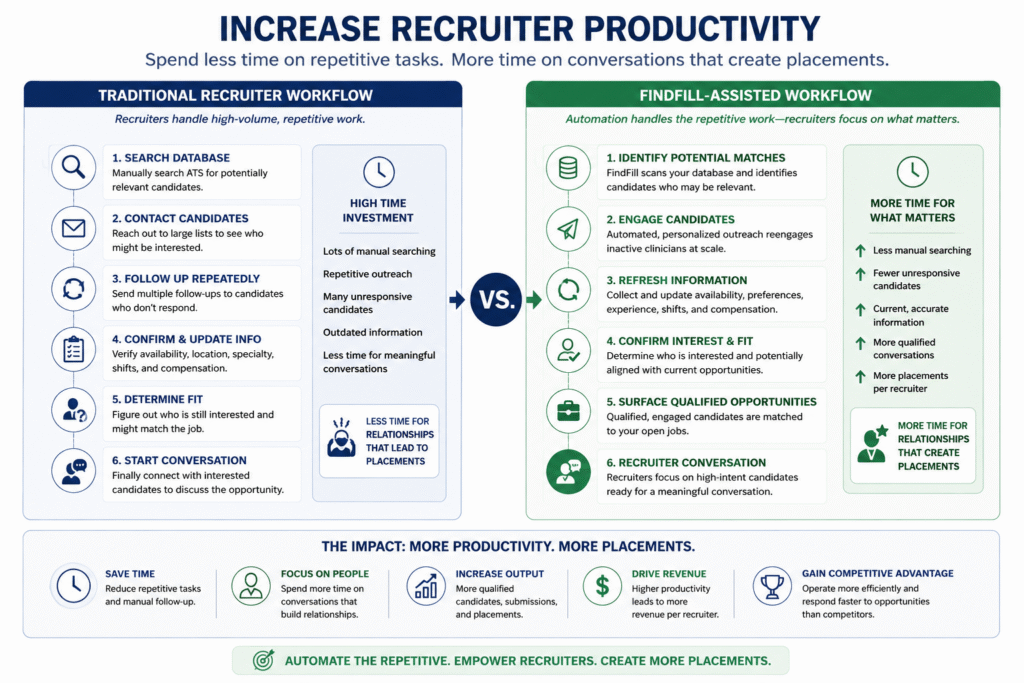
The recruiter becomes involved when candidate intent has already been established.
That distinction matters because recruiter time is limited.
Every hour spent repeatedly contacting candidates who never respond is an hour that cannot be spent building relationships with clinicians who are actively considering an opportunity.
Use New Jobs to Create Recruiting Opportunities
Recruiter productivity can also improve when agencies connect new job openings directly to their existing candidate database.
Traditionally, a recruiter may receive a new position and manually search for candidates who appear qualified.
A more systematic workflow can use the job itself as the trigger.
New Job Opens → Identify Potential Candidates → Reengage Existing Clinicians → Confirm Current Preferences → Identify Interested Matches → Route to Recruiter
This allows agencies to continuously reconsider their existing candidate supply as new demand enters the organization.
A clinician who was not relevant for yesterday’s jobs may be an excellent fit for a position that opens today.
Reduce Time Spent Chasing Unresponsive Candidates
Follow-up is part of recruiting.
Repeatedly following up with large numbers of unresponsive candidates, however, can consume substantial recruiter capacity.
Automated reengagement can help agencies determine who is willing to restart a conversation before requiring significant recruiter involvement.
Candidates who respond can be prioritized.
Candidates who do not respond can remain available for future reengagement without requiring a recruiter to manually work the same list repeatedly.
The objective is not to eliminate follow-up.
It is to make recruiter follow-up more intentional.
Keep Candidate Information Current
Outdated candidate information creates another productivity problem.
A clinician’s circumstances may have changed since entering the database.
They may have:
- Obtained a new license
- Changed specialties
- Gained additional experience
- Changed preferred states
- Changed shift preferences
- Changed compensation expectations
- Completed another assignment
- Become available sooner than expected
When recruiters rely entirely on historical ATS information, they may spend time pursuing opportunities that no longer align with the candidate.
Reengagement gives agencies an opportunity to refresh this information before recruiters invest significant time.
Measure Recruiter Productivity Around Outcomes
Leadership teams should monitor more than raw outreach volume.
Useful recruiter productivity metrics may include:
- Qualified candidate conversations per recruiter
- Candidate response rate
- Candidates reactivated
- Qualified candidates surfaced
- Submissions per recruiter
- Interviews per recruiter
- Placements per recruiter
- Time from job opening to qualified candidate
- Percentage of placements generated from existing database candidates
- Gross profit generated per recruiter
These metrics help distinguish between recruiter activity and recruiter output.
The objective should not simply be more calls or more texts.
The objective should be more productive conversations that can become placements.
AI Should Expand Recruiter Capacity, Not Replace Recruiters
Recruiting remains a relationship-driven function.
Candidates still need people who can understand their priorities, explain opportunities, answer questions, navigate concerns, build trust, and help them make career decisions.
AI and automation are better suited for repetitive, high-volume activities.
These may include:
- Initial candidate outreach
- Reengagement
- Follow-up
- Preference collection
- Availability updates
- Basic qualification
- Identifying potential job matches
Recruiters can then focus on the parts of recruiting where human judgment and relationship building create the most value.
The goal of recruiting automation should not be fewer recruiter conversations. It should be fewer wasted recruiter conversations.
A Practical Recruiter Productivity Framework
Healthcare staffing agencies looking to increase recruiter productivity can begin with a simple process.
Step 1: Segment the Existing Database
Identify clinicians who may be appropriate for reengagement based on profession, specialty, location, experience, or other relevant criteria.
Step 2: Reengage Candidates Systematically
Create a consistent process for reconnecting with clinicians rather than relying entirely on individual recruiters to manually revisit old records.
Step 3: Refresh Candidate Information
Confirm current preferences, availability, experience, and other information required to evaluate potential opportunities.
Step 4: Connect Candidates With Current Jobs
Compare refreshed candidate information against available positions.
Step 5: Prioritize Engaged Candidates
Give recruiters visibility into candidates who have demonstrated current interest rather than treating every database record equally.
Step 6: Route Opportunities to Recruiters
Once a potentially qualified and interested candidate is identified, transition the conversation to the appropriate recruiter.
Step 7: Measure Placement Outcomes
Track whether reactivated candidates progress into submissions, interviews, placements, and gross profit.
This creates a feedback loop that helps the agency understand whether database reengagement is actually increasing recruiter output.
Frequently Asked Questions
How can healthcare staffing recruiters become more productive?
Agencies can improve recruiter productivity by reducing repetitive sourcing, outreach, follow-up, and qualification work so recruiters can spend more time speaking with engaged and potentially qualified clinicians.
Can AI replace healthcare staffing recruiters?
AI can automate portions of candidate outreach, reengagement, preference collection, and basic qualification. Relationship building, opportunity presentation, objection handling, and candidate decision-making still benefit significantly from human recruiters.
What healthcare staffing recruiting tasks can be automated?
Initial outreach, follow-up, candidate rediscovery, preference updates, availability confirmation, basic qualification, and identification of potential job matches can all be partially automated.
How can staffing agencies get more value from their ATS?
Agencies can systematically reengage candidates already stored in the ATS, refresh outdated information, and identify clinicians who may fit current opportunities instead of relying exclusively on manual recruiter searches.
Does recruiting automation reduce the need for recruiters?
Not necessarily. Effective automation can increase the number of qualified opportunities each recruiter can manage by reducing the repetitive work required before meaningful recruiter involvement.
Give Recruiters More Time for the Conversations That Create Placements
Healthcare staffing agencies have already invested significant time and money acquiring the clinicians inside their databases.
The challenge is making those relationships easier for recruiters to use.
FindFill helps staffing agencies reengage existing clinicians, refresh candidate preferences, identify potential job matches, and surface qualified opportunities so recruiters can focus their time where human interaction matters most.
Learn how FindFill helps staffing agencies reengage existing candidate databases →