
How to Build an Internal Float Pool Across Multiple Nursing Facilities
What Is an Internal Float Pool?
An internal float pool is a group of employees who can help cover staffing needs beyond a single assigned unit, department, or facility.
In a multi-facility nursing organization, the concept can extend beyond a traditional centralized float team. Employees who primarily work at one community may also be eligible to pick up available shifts at participating sister communities.
This creates a broader internal workforce without necessarily adding new employees.
Instead of viewing staffing capacity building by building, operators can begin viewing eligible employees across nearby facilities as part of a connected workforce.
Traditional Building-Level Staffing
Community A
Open shift → Community A employees
Community B
Open shift → Community B employees
Community C
Open shift → Community C employees
Each building primarily attempts to solve its own staffing gaps.
Connected Internal Float Pool
Community A + Community B + Community C
Open shifts across participating communities → eligible employees across the group
The employees still maintain their normal employment relationships and primary locations. The difference is that appropriate opportunities can become visible beyond the four walls of one building.
Why Multi-Facility Operators Have an Internal Visibility Problem
A staffing shortage at one building does not always mean the organization is out of available employees.
Consider three facilities located 20 or 30 minutes apart.
Community A may have an open CNA shift Tuesday evening.
At the same time:
- Community B may have CNAs looking for additional hours.
- Community C may have PRN employees who are available.
- Neither group may know Community A needs help.
- Community A’s scheduler may have no simple way to reach them.
The organization has both a staffing need and potentially available internal capacity.
The problem is visibility.
Without a system connecting those two sides, Community A may eventually seek overtime, bonuses, agency staffing, or another outside resource even though an existing employee elsewhere in the organization may have wanted the shift.
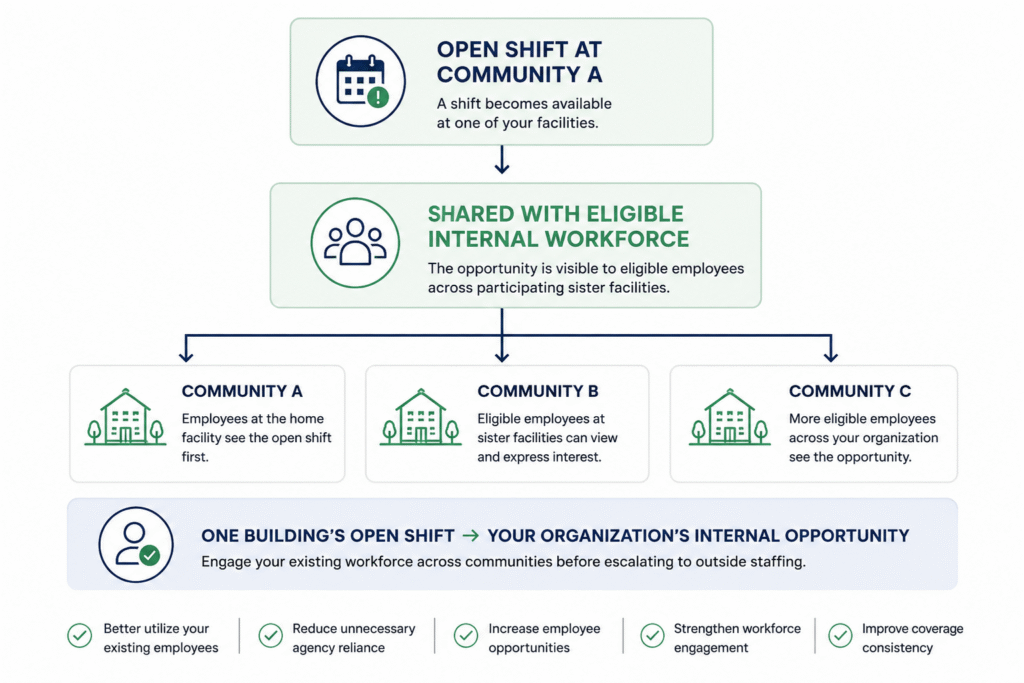
The Core Principle: Look Across Before Looking Outside
An internal float pool creates another step in the staffing process.
Instead of:
Open Shift → Home Facility Employees → Outside Staffing
the organization can use:
Open Shift → Home Facility Employees → Eligible Sister-Facility Employees → Outside Staffing When Necessary
This does not eliminate outside staffing.
It makes external staffing a later escalation point after the organization has first exposed the opportunity to its available internal workforce.
Key Insight: An Open Shift at One Building Can Be an Opportunity for an Employee at Another.
Better internal visibility allows organizations to discover capacity that already exists before assuming additional labor must come from outside.
Step 1: Determine Which Facilities Can Participate
Not every facility in a large organization should necessarily share one float pool.
Start geographically.
Identify clusters of sister facilities located close enough that employees could reasonably travel between them for additional shifts.
Factors to consider include:
- Driving distance
- Typical commute times
- Employee willingness to travel
- State or licensing requirements
- Facility-specific credentialing requirements
- Organizational policies
- Payroll and employment structure
or some operators, this may mean three facilities within 30 minutes of one another.
For others, it could mean five or six buildings within approximately an hour.
The objective is not to create the largest possible pool. It is to create a practical internal labor market employees will actually use.
Step 2: Define Employee Eligibility
Greater shift visibility does not mean every employee should be eligible for every shift.
Establish clear rules determining who can work where.
Eligibility may depend on:
- Role
- License
- Certification
- Orientation requirements
- Employment status
- Overtime rules
- Facility-specific competencies
- Geographic location
- Current standing with the organization
A CNA should only see appropriate CNA opportunities.
An employee who has not completed required onboarding for a particular facility should not automatically be treated as eligible to work there.
The float pool should expand opportunity without sacrificing operational control.
Step 3: Establish Cross-Facility Policies
Before opening shifts across buildings, define how the process will work operationally.
Leadership should answer questions such as:
- Can employees freely work across participating facilities?
- Does an employee need approval from their home building?
- Who approves an employee for a shift?
- How is overtime handled?
- Which building absorbs the labor cost?
- Are differentials or incentives available?
- What happens if two employees request the same shift?
- Can employees work at another facility without prior orientation?
- Who is responsible for maintaining eligibility?
Document these rules before expanding the program.
A float pool becomes much easier to manage when schedulers and employees understand the same expectations.
Step 4: Create an Internal-First Shift Escalation Process
The next step is deciding when an open shift becomes visible to different groups.
One example:
Tier 1: Home Facility
First expose the shift to eligible employees at the facility where the opening exists.
Tier 2: Internal Float Pool
If the shift remains open, make it available to eligible employees at participating sister facilities.
Tier 3: External Coverage
If internal coverage is unavailable, escalate to the organization’s approved outside staffing resources.
Organizations can adjust the timing based on urgency.
A shift occurring tomorrow may move through the process quickly. A shift several weeks away may remain internally available longer.
What matters is establishing a repeatable escalation process instead of allowing every scheduler to independently decide when to seek outside help.
Step 5: Make Open Shifts Easy for Employees to See
A float pool only works if employees know opportunities exist.
This is where many informal programs break down.
Schedulers may rely on:
- Group texts
- Phone calls
- Email chains
- Spreadsheets
- Messaging apps
- Individual relationships with employees
- Word of mouth
Those methods can work at a small scale, but become increasingly difficult as more buildings and employees participate.
Employees need a simple way to know:
- A shift is available.
- They are eligible for it.
- Where the shift is located.
- When it occurs.
- How to express interest.
The easier that process becomes, the more usable the organization’s internal float pool becomes.
Step 6: Keep Facility Leadership in Control
An internal float pool should increase employee access to opportunities without taking staffing decisions away from facility leadership.
Depending on organizational policy, administrators and schedulers may still control:
- Employee eligibility
- Which shifts are shared
- Which facilities participate
- Whether requests require approval
- Who receives a particular shift
- When an open shift escalates externally
Technology should make internal opportunities easier to see and coordinate.
It should not force operators to surrender control over who works in their buildings.
Step 7: Give Employees a Reason to Participate
An internal float pool creates benefits for the organization, but it also needs to create value for employees.
The most obvious benefit is access to additional hours.
An employee whose home facility has no extra shifts available may still want to work.
Another facility within the organization may need exactly that employee.
Greater visibility can give employees:
- More opportunities for additional hours
- More flexibility over when they work
- Access to opportunities beyond their primary building
- A reason to seek additional work internally rather than elsewhere
This turns staffing coverage into an employee engagement opportunity as well as an operational strategy.
Step 8: Measure Whether the Float Pool Is Actually Working
Do not measure success simply by whether the program exists.
Track whether employees are actually using it.
Useful monthly metrics include:
| Metric | What It Tells You |
| Open shifts posted | Total internal coverage opportunity |
| Shifts filled internally | Effectiveness of internal activation |
| Cross-facility shifts filled | Whether employees are moving across buildings |
| Participating employees | Breadth of employee engagement |
| Average time to fill | Speed of internal response |
| Unfilled shifts | Remaining coverage gaps |
| Outside staffing hours | External coverage still required |
| Overtime hours | Whether internal coverage is affecting overtime |
| Repeat float employees | Whether employees find the program worthwhile |
One especially useful metric is:
Internal Fill Rate
Internally Filled Open Shifts ÷ Total Open Shifts Posted
Track this over time and by facility.
The objective is not necessarily a 100% internal fill rate. The goal is to understand how much existing workforce capacity the organization can capture before escalating externally.
Internal Float Pool vs. Traditional PRN Pool
These concepts overlap, but they are not necessarily identical.
| Traditional PRN Pool | Cross-Facility Internal Float Pool |
| May consist of designated PRN employees | Can include eligible existing employees |
| Often centrally managed | Can connect employees across participating buildings |
| Employees may be hired specifically to float | Employees can retain a primary home facility |
| Creates dedicated flexible capacity | Expands visibility into existing capacity |
| Requires maintaining the pool | Can complement an existing PRN program |
Organizations do not necessarily need to choose between them.
A centralized PRN pool can provide dedicated flexible capacity while cross-facility visibility gives the organization another way to engage employees already working throughout its buildings.
Common Internal Float Pool Mistakes
1. Treating Every Facility as an Island
If nearby buildings never see one another’s staffing capacity, the organization loses much of the advantage of operating multiple locations.
2. Making the Process Too Manual
If schedulers must individually call or text dozens of employees, internal-first staffing becomes difficult to maintain consistently.
3. Failing to Define Eligibility
Greater access without appropriate controls can create operational problems.
4. Ignoring the Employee Experience
Employees will not participate consistently if finding and requesting shifts is cumbersome.
5. Measuring Only Agency Spend
Agency reduction can be an outcome, but also measure internal fills, cross-building participation, response rates, and employee engagement.
6. Making the Pool Too Geographically Broad
More facilities do not automatically create a better float pool. Employees need to be realistically willing to travel between participating locations.
How FindFill Supports a Multi-Facility Internal Float Pool
FindFill is designed to make the communication and visibility layer of an internal float pool easier to operate.
A participating facility posts an available shift.
FindFill can then make that opportunity visible to eligible employees at the home facility and participating sister facilities.
Employees who want the shift can respond to the opportunity, while the organization maintains control over eligibility and shift awarding.
The result is a simple workflow:
Post the Open Shift → Notify Eligible Employees → Employees Respond → Fill Internally
FindFill does not replace a facility’s scheduling system or create another workforce.
It helps operators make better use of the workforce they already have by making internal opportunities easier to see across participating communities.
Your Workforce Is Bigger Than Each Individual Building.
The challenge is making available shifts and available employees visible to one another.
Frequently Asked Questions
Do employees have to change their home facility to join an internal float pool?
Not necessarily. A cross-facility model can allow employees to retain their primary building while gaining access to eligible opportunities at participating sister facilities.
How close should facilities be for an internal float pool?
There is no universal distance. Organizations should consider realistic commute times and employee willingness to travel. Nearby geographic clusters generally make participation easier.
Can an internal float pool reduce agency staffing?
It can reduce agency utilization when an eligible internal employee is available and willing to cover a shift that otherwise would have escalated externally. Agency staffing can still remain an important resource when internal coverage is unavailable.
Can PRN employees participate?
Yes, depending on organizational policy. Full-time, part-time, and PRN employees can potentially participate when they meet the organization’s eligibility requirements.
Does FindFill replace scheduling software?
No. FindFill focuses on making open shifts visible to eligible internal employees and facilitating the shift-fill process. It is not intended to replace the organization’s scheduling system.
Who decides which employee gets the shift?
The organization does. Participating facilities can maintain control over employee eligibility and how shifts are awarded.
Build the Float Pool You Already Have
Your organization may already employ hundreds or thousands of people across nearby facilities.
The opportunity is making that workforce easier to access.
FindFill helps multi-facility senior living organizations make open shifts visible across participating communities so eligible employees can find and respond to additional work before operators have to look outside
Looking for the broader agency-reduction framework?
Read: How to Reduce Agency Spend in Skilled Nursing Facilities →