
WORKFORCE TECHNOLOGY
What Is a VMS in Healthcare Staffing?
Understand how healthcare staffing VMS platforms work and how an internal-first model connects internal workforce utilization with approved agency support.
A vendor management system, or VMS, is technology healthcare organizations use to manage staffing suppliers and the workflows associated with external workforce coverage.
Depending on the platform, that can include distributing staffing needs, controlling agency access, reviewing candidate submissions, awarding work, managing timecards, and creating greater visibility into contingent labor.
For many healthcare organizations, however, workforce coverage begins before a shift ever needs to be sent to an outside staffing agency.
There may already be employees at the building, PRN staff, float-pool resources, or qualified employees at nearby sister communities who could cover the need.
That is where an internal-first VMS takes a broader approach.
FindFill brings internal workforce activation and approved agency support into one workflow. Open shifts can first be made available to eligible internal employees and participating sister communities. If the need remains open, it can then move to staffing agencies approved by the organization.
The result is one workforce workflow spanning internal resources and external coverage.
What Does VMS Mean in Healthcare Staffing?
VMS stands for vendor management system.
In healthcare staffing, a VMS generally provides centralized infrastructure for managing relationships and workflows involving outside staffing suppliers.
Organizations may use a VMS to:
- Distribute open staffing needs to approved agencies
- Control which staffing suppliers have access
- Review candidate submissions
- Award staffing needs
- Manage agency timecards
- Centralize supplier activity
- Improve visibility into external workforce usage
Instead of managing each staffing agency through separate emails, spreadsheets, portals, and processes, the VMS creates a more consistent workflow.
For organizations using multiple staffing agencies, that can significantly simplify external workforce administration.
How Traditional Healthcare Staffing VMS Models Work
A traditional healthcare staffing VMS often becomes most visible once an organization has determined that external staffing is needed.
A common workflow might look like:
Open Need → Approved Staffing Agencies → Candidate Submissions → Facility Review → Award → Timecard
This solves an important problem.
Rather than logging into multiple staffing-agency platforms or coordinating each supplier independently, the organization gains a centralized way to manage external staffing.
But there is another question worth asking:
What happened before the shift became an agency requirement?
That is where the distinction between a traditional external-staffing workflow and an internal-first workforce model becomes important.
What Traditional VMS Workflows Can Leave Separate
Healthcare organizations may already have substantial workforce capacity inside the organization.
That can include:
- Full-time employees seeking additional hours
- Part-time employees
- PRN staff
- Internal float-pool employees
- Employees at nearby sister locations
- Other eligible internal workforce resources
Yet those employees may not have visibility into an open need at another building or even within their own organization.
If the internal workforce workflow and the agency workflow operate separately, a staffing need can move to external staffing before all available internal resources have had a meaningful opportunity to cover it.
An internal-first model connects those layers.
What Is an Internal-First VMS?
An internal-first VMS expands the workforce workflow upstream.
Instead of beginning only when a staffing need is ready for an external supplier, the process begins with the organization’s own workforce.
The basic FindFill model is:
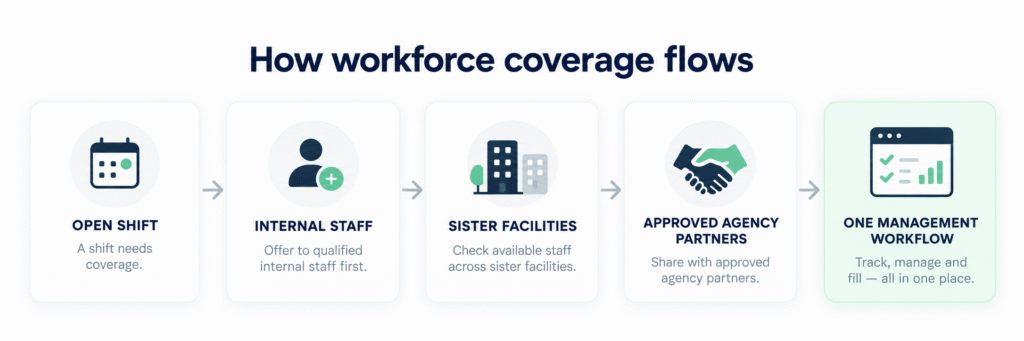
Internal employees receive the first opportunity to cover available shifts.
Where organizational policies allow it, eligible employees at participating sister communities can also receive visibility.
If internal resources cannot cover the need, the remaining shift can then be distributed to staffing agencies specifically approved by the organization.
Internal and agency applicants can be managed through the same broader workflow.
The facility remains in control throughout the process.
How FindFill’s Internal-First Workforce Workflow Works
1. An Open Shift Is Created
A staffing need becomes available at the community.
The organization determines which employees are eligible to view or respond to the opportunity.
2. Internal Employees Receive The First Opportunity
Eligible employees at the facility can receive visibility into the open shift.
This gives the organization an opportunity to use workforce capacity it already employs before purchasing additional outside staffing.
3. Visibility Can Expand Across Participating Sister Communities
If the organization allows employees to work across locations, eligible staff at participating sister communities can also receive visibility into the open need.
This can create a broader internal resource pool without requiring the organization to recruit additional employees specifically for every location.
4. Remaining Needs Can Move To Approved Agency Partners
If the internal workforce cannot cover the shift, the remaining need can be distributed to staffing agencies authorized by the organization.
The facility determines which staffing agencies are permitted to participate.
FindFill does not require an organization to use multiple agencies.
5. Internal And Agency Applicants Can Be Reviewed In One Place
The facility can review applicants and determine who should receive the shift without managing completely separate internal and external staffing workflows.
That creates greater visibility into the entire coverage process.
6. Agency Timecards Can Stay In The Same Workflow
When an agency clinician works through FindFill, agency timecards can also be reviewed through the platform.
The result is one place to manage more of the workforce process from internal coverage through approved external support.
Traditional VMS vs. Internal-First VMS
| Traditional VMS | Internal-First VMS | |
|---|---|---|
| Where the workflow begins | Often with an external staffing requirement | With the open workforce need |
| Internal employees | Often managed separately | Included in the coverage workflow |
| Sister-community workforce | Often outside the VMS workflow | Can be incorporated where permitted |
| External agencies | Central part of the workflow | Used when internal coverage is insufficient |
| Supplier control | Organization controls approved vendors | Organization controls approved agencies |
| Applicant review | Primarily external submissions | Internal and agency applicants can be reviewed in one workflow |
| Timecards | Often centralized for agency labor | Agency timecards can remain centralized |
| Primary objective | Manage external staffing suppliers | Coordinate internal-first staffing and approved agency support |
The distinction is not that one model uses staffing agencies and the other does not.
Both can include external staffing.
The difference is where the workforce workflow begins.
Why Internal-First Staffing Matters for Senior Living
Senior living organizations often operate multiple communities within the same region.
One building may have an open shift while another has an employee interested in additional hours.
Without visibility across those locations, the organization may never connect the employee with the opportunity.
That can create avoidable outside staffing usage even when qualified internal employees are available somewhere within the organization.
An internal-first workflow can help senior living operators:
- Increase visibility into available internal workforce capacity
- Give employees more access to open shifts
- Connect nearby communities
- Build more effective internal float-pool models
- Reduce unnecessary reliance on outside staffing
- Maintain agency coverage for needs internal resources cannot solve
- Centralize workforce activity in one place
The goal is not to eliminate external staffing.
The goal is to use each workforce resource more intentionally.
Internal First Does Not Mean Agency Last
Prioritizing internal employees does not mean staffing agencies become unimportant.
Healthcare organizations will continue to face legitimate coverage needs that their own employees cannot solve.
Examples may include:
- Unexpected call-offs
- Vacancies
- Leaves of absence
- Weekend and overnight gaps
- Difficult-to-fill shifts
- Census changes
- Specialized clinical requirements
- Temporary increases in demand
Approved staffing agencies remain an important coverage layer when internal resources are insufficient.
The difference is that external staffing becomes part of a coordinated escalation process rather than automatically being the first destination for every uncovered shift.
What Does The Facility Control?
The senior living organization remains in control of its workforce strategy.
The facility determines:
- Which employees are eligible to participate
- Which communities can share workforce visibility
- Which staffing agencies are approved
- When external staffing is used
- Which applicants receive shifts
- How agency relationships are managed
FindFill does not dictate the organization’s agency network.
If a facility wants to work with one approved agency, it can.
If it wants to work with multiple agencies, it can.
The technology supports the organization’s workforce strategy rather than determining it.
Is FindFill A VMS?
Yes.
FindFill functions as an internal-first VMS for senior living workforce coverage.
The important distinction is that FindFill does not wait until a staffing need has already become an agency requirement.
The workflow begins with the organization’s internal workforce.
Eligible employees can receive visibility into open shifts first. The opportunity can expand across participating sister communities. If internal resources cannot cover the need, approved staffing agencies can then support the remaining requirement.
Internal and external coverage operate within one broader workforce workflow.
Does FindFill Replace A Staffing Agency?
No.
FindFill is workforce infrastructure, not a staffing agency.
Staffing agencies continue to recruit, employ or contract with clinicians, maintain their clinician relationships, and provide external workforce coverage.
FindFill gives the facility infrastructure for coordinating when and how those external resources enter the broader staffing workflow.
Does An Internal-First VMS Eliminate Agency Use?
No.
An internal-first VMS gives internal resources the first opportunity to cover open needs.
If those resources are unavailable or insufficient, approved agencies remain available to provide additional coverage.
The goal is to reduce unnecessary agency utilization without removing access to external staffing when it is genuinely needed.
What Are The Potential Benefits Of An Internal-First VMS?
An internal-first workforce model can help organizations create greater visibility and control across the staffing process.
Potential benefits include:
Greater Internal Workforce Utilization
Employees can gain greater visibility into open shifts that may otherwise go unnoticed.
Stronger Cross-Community Staffing
Organizations with nearby locations can make it easier for eligible employees to help sister communities.
More Intentional Agency Usage
Agency support remains available but enters the process when internal resources are insufficient.
Fewer Disconnected Workflows
Internal staffing, agency applicants, shift awards, and agency timecards can be managed through a more centralized process.
Better Workforce Visibility
Leadership gains a clearer picture of how internal and external resources are being used to cover staffing needs.
What Should Senior Living Organizations Look For In A VMS?
When evaluating workforce technology, operators should look beyond whether a platform can distribute needs to staffing agencies.
Questions worth asking include:
- Does the platform include our internal workforce?
- Can employees see open shifts across participating communities?
- Can we determine which employees are eligible?
- Can we control which staffing agencies participate?
- Can internal and agency applicants be reviewed in one place?
- Can shifts be awarded through the same workflow?
- Can agency timecards be managed centrally?
- Does the platform require us to change our existing staffing-agency relationships?
- Can we use internal resources first without losing access to external coverage?
- How quickly can the system be implemented?
The right technology should support the workforce strategy the organization wants to operate.
Frequently Asked Questions About Healthcare Staffing VMS Platforms
What does VMS stand for in healthcare staffing?
VMS stands for vendor management system. It generally refers to technology used to centralize the management of external staffing suppliers and related workforce workflows.
What is the difference between a VMS and a staffing agency?
A staffing agency supplies external clinicians.
A VMS provides technology and workflow infrastructure for managing staffing suppliers and workforce activity.
FindFill is not a staffing agency.
What is an internal-first VMS?
An internal-first VMS begins the staffing workflow with the organization’s own workforce rather than beginning only after a shift has become an external staffing requirement.
Internal employees receive the first opportunity to cover the need, followed by approved external staffing partners when necessary.
Can FindFill work with our existing staffing agencies?
Yes.
The facility determines which staffing agencies are authorized to participate.
FindFill is designed to support the organization’s existing workforce strategy rather than require a particular agency network.
Does FindFill require multiple staffing agencies?
No.
Facilities remain in control of which agencies participate and are not required to add multiple suppliers.
Can internal and agency applicants be reviewed together?
Yes.
FindFill can give facilities one place to review internal and agency applicants as part of the same broader workforce coverage process.
How are agency timecards handled?
Agency timecards can be managed through FindFill, reducing the need for facilities to move between multiple supplier platforms for timecard administration.
Is FindFill designed specifically for senior living?
FindFill’s internal-first workforce model is designed around the staffing challenges of senior living organizations, particularly operators with multiple nearby communities and opportunities to improve internal workforce utilization across locations.
Related Resources
Internal PRN vs Agency Staffing
Cost, reliability, and tradeoffs between internal PRN pools and agencies.
The 3-Tier Staffing Model for Post-Acute Care
A structured staffing framework balancing internal stability, flexible coverage, and agency escalation.
Manage External Staffing Better. But Activate Internal Staffing First.
A VMS can help manage the vendors you use when outside coverage is necessary. FindFill helps make open shifts visible to eligible employees across participating communities before operators need to look outside.